
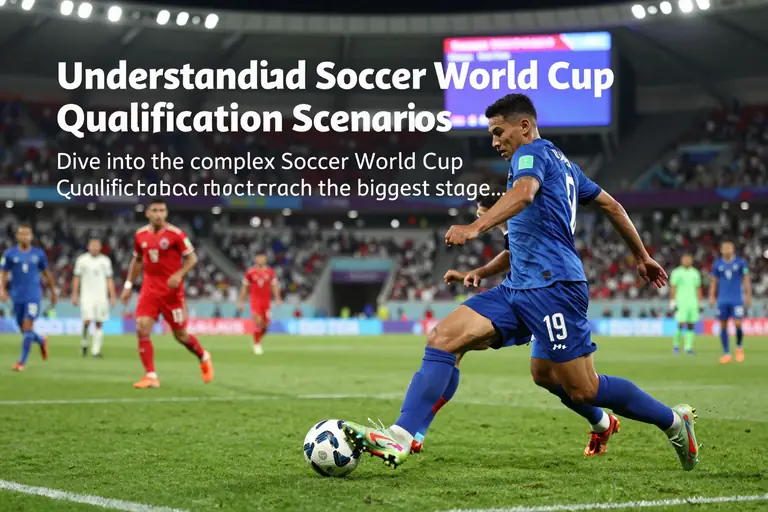
The Road to the World Cup: Unpacking Soccer World Cup Qualification Scenarios
As football fans, we all dream of seeing our favorite nations compete on the grandest stage. The journey to the FIFA World Cup is a long and arduous one, filled with drama, unexpected twists, and nail-biting finishes. Understanding the various Soccer World Cup qualification scenarios is key to appreciating the immense effort and strategy involved. This process isn’t just about winning games; it’s about navigating complex group stages, knockout rounds, and sometimes, intercontinental playoffs, all under immense pressure.
For the upcoming 2026 tournament, the expansion to 48 teams has significantly altered the qualification landscape, offering more berths and new pathways for nations across all confederations. This change means that while the competition remains fierce, more teams have a realistic shot at making it to the final tournament.
Competition Format Overview
The FIFA World Cup qualification process is divided among its six confederations: AFC (Asia), CAF (Africa), CONCACAF (North, Central America, and Caribbean), CONMEBOL (South America), OFC (Oceania), and UEFA (Europe). Each confederation has its own unique format, tailored to the number of member associations and the allocation of World Cup slots. With the expansion to 48 teams, the number of direct qualification spots for each confederation has increased, alongside the introduction of a new intercontinental playoff tournament.
- AFC (Asia): Expected to have 8 direct slots, plus one intercontinental playoff spot. The format typically involves multiple rounds, starting with preliminary matches and progressing to group stages.
- CAF (Africa): Set to receive 9 direct slots, plus one intercontinental playoff spot. African qualification is notoriously tough, often featuring extensive group stages.
- CONCACAF (North, Central America, and Caribbean): With co-hosts USA, Canada, and Mexico automatically qualifying, the confederation will have 3 additional direct slots, plus two intercontinental playoff spots. This region often sees a mix of group play and a final hexagonal or octagonal round.
- CONMEBOL (South America): Expected to have 6 direct slots, plus one intercontinental playoff spot. South America famously uses a single round-robin league format, where all ten teams play each other home and away.
- OFC (Oceania): Historically a region with limited direct access, OFC will now have 1 direct slot, plus one intercontinental playoff spot, a significant boost for its member nations.
- UEFA (Europe): As the largest confederation, Europe will have 16 direct slots. Their qualification typically involves group stages, with group winners qualifying directly and play-offs deciding the remaining spots.
The intercontinental playoff tournament will feature six teams competing for the final two World Cup berths. This mini-tournament adds another layer of excitement and a last-chance saloon for hopeful nations.
Current Situation and Key Scenarios
As qualification cycles begin, every match holds significant weight. Teams are constantly calculating their standing, looking at goal difference, head-to-head records, and the remaining fixtures. For many, the goal isn’t just to win, but to win by a certain margin or to deny a rival points. This strategic thinking defines many Soccer World Cup qualification scenarios.
For example, in a tight group, a team might need to win their final match by two goals to overtake another on goal difference. Or, if a direct rival drops points in an earlier game, a draw might suddenly be enough for qualification. These situations create immense drama and require teams to be adaptable and focused until the very last whistle. We often see teams needing a specific result from another match to go their way, adding to the tension for fans watching from afar. For all the latest updates, remember to check Soccer World Cup Highlights Today.
Team Analysis: The Contenders and the Underdogs
Every qualification cycle sees established powerhouses, rising contenders, and plucky underdogs. The expansion to 48 teams means that some nations which previously found qualification almost impossible now have a realistic target. This can lead to increased investment in football development within those countries, fostering growth in the sport globally.
For traditional footballing nations, the focus is often on securing qualification early and using the remaining matches to test new players or tactics. For others, every single point is a battle, and reaching the World Cup would be a historic achievement. The pressure on these teams is immense, as qualification can bring not only national pride but also significant financial benefits and exposure.
Historical Context: Lessons from Past Campaigns
History is replete with examples of dramatic qualification campaigns. We’ve seen teams qualify on the final day, through sudden-death playoffs, and even on fair play points. These stories serve as a reminder that nothing is guaranteed until the final whistle blows. Remember the agony of Italy missing out on the 2018 World Cup, or the joy of Iceland making their debut in the same tournament?
These historical moments highlight the unpredictable nature of football and the emotional rollercoaster that is World Cup qualification. They also show how small margins can have enormous consequences. A single missed penalty, a late equalizer, or a controversial referee decision can alter the course of a nation’s footballing destiny.
Practical Tips for Fans Following Qualification
Following the Soccer World Cup qualification scenarios can be exhilarating, but also complex. Here are a few tips to help you stay on top of all the action:
- Understand the Format: Familiarize yourself with your confederation’s specific qualification rules, including how tie-breakers work (e.g., goal difference, head-to-head records).
- Track Standings Regularly: Keep an eye on group tables. Even small point differences can be crucial.
- Check Fixture Lists: Know which teams are playing whom, and when. The order of matches can significantly impact scenarios.
- Watch for Key Match-ups: “Six-pointer” matches between direct rivals are often decisive.
- Consider Goal Difference: In many formats, goal difference can be the deciding factor when teams are level on points.
By staying informed, you’ll be better equipped to understand the permutations and appreciate the high stakes involved in every game on the road to the World Cup.
FAQ
What happens if teams are tied on points in World Cup qualification?
Tie-breaking criteria vary by confederation but typically involve goal difference, then goals scored, and potentially head-to-head records between the tied teams. Some confederations may also use fair play points or even a playoff match.
How many teams qualify for the 2026 FIFA World Cup?
The 2026 FIFA World Cup will feature 48 teams, an expansion from the previous 32-team format. This allows for more representation from various confederations.
What is the intercontinental playoff tournament?
The intercontinental playoff tournament is a final mini-tournament involving six teams from different confederations (excluding UEFA) competing for the last two available spots at the World Cup finals.