Understanding the Foundation: The World Cup Group Stage
The FIFA World Cup, often simply called the World Cup, is an international association football competition contested by the senior men’s national teams of the members of FIFA, the sport’s global governing body. Held every four years, it is the most prestigious football tournament in the world. Before the thrilling knockout rounds, teams must first navigate the group stage, where every match, every goal, and every point contributes to their standing. This initial phase is crucial, setting the tone for a team’s entire tournament journey and often providing some of the most dramatic storylines.
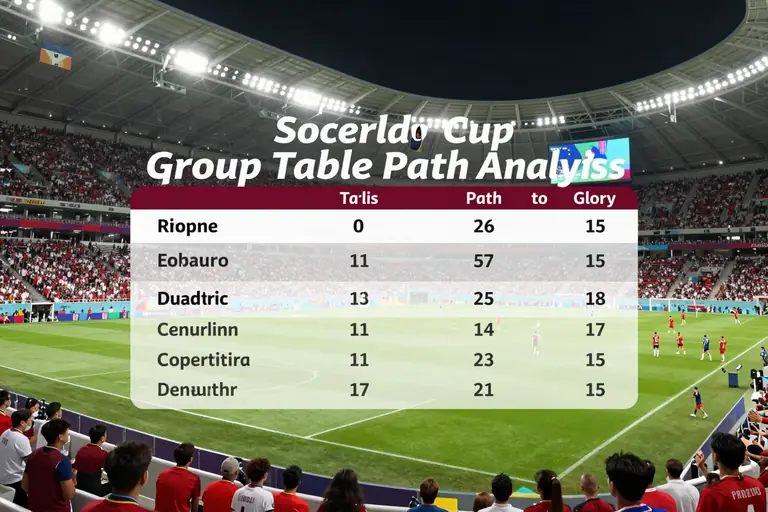
The group stage typically involves 32 teams (though this number is set to expand in future tournaments), divided into eight groups of four. Each team within a group plays every other team in that group once, resulting in three matches per team. These matches are not just about winning; they are about accumulating points, managing goal difference, and sometimes, even keeping an eye on disciplinary records. A thorough analysis of the Soccer World Cup group table is essential for fans, pundits, and coaches alike to predict outcomes and understand the permutations.
The Points System: How Teams Advance
The primary objective for any team in the group stage is to finish among the top two in their respective group. This guarantees progression to the knockout stage, where the competition intensifies significantly. The points system is straightforward:
- Win: 3 points
- Draw: 1 point
- Loss: 0 points
At the end of all group matches, teams are ranked based on the total points accumulated. The higher the points, the better the position. However, it’s rarely as simple as just adding up points. Often, teams end up with the same number of points, necessitating a series of tie-breaking criteria to determine their final ranking in the Soccer World Cup Group Table Analysis.
Deciphering Tie-Breakers: More Than Just Points
When two or more teams are level on points, FIFA employs a specific set of criteria to separate them. Understanding these rules is vital, as they can dramatically alter a team’s fate. Here’s the order of tie-breakers:
- Goal Difference: The difference between goals scored and goals conceded in all group matches. A higher goal difference is always better. This is often the first and most common tie-breaker after points.
- Goals Scored: The total number of goals scored in all group matches. If goal difference is equal, the team that has scored more goals will be ranked higher.
- Points in Matches Between Tied Teams: If teams are still tied after the first two criteria, their head-to-head record comes into play. Points obtained in the matches between the teams concerned are considered.
- Goal Difference in Matches Between Tied Teams: If the head-to-head points are also equal, the goal difference from the matches played only between the tied teams is used.
- Goals Scored in Matches Between Tied Teams: If still tied, the number of goals scored in the matches played only between the tied teams is considered.
- Fair Play Points: This is a more recent addition and can be a significant factor. Fair play points are calculated based on yellow and red cards received during the group stage.
- Yellow card: -1 point
- Indirect red card (two yellow cards): -3 points
- Direct red card: -4 points
- Yellow card and direct red card: -5 points
The team with the highest fair play score (i.e., fewest penalty points) is ranked higher.
- Drawing of Lots: In the rare event that all the above criteria fail to separate teams, a drawing of lots by the FIFA Organizing Committee is conducted. While extremely uncommon, it underscores the meticulous detail involved in every aspect of the Soccer World Cup Group Table Analysis.
These tie-breakers highlight that every single goal, every tackle, and every foul can have profound implications for a team’s progression. It’s not just about winning, but winning convincingly, and doing so cleanly.
Strategic Plays and Group Dynamics
The Soccer World Cup Group Table Analysis is not just a static record of past results; it’s a dynamic entity influenced by strategic decisions. Coaches often have to make tough choices based on their current standing and future opponents. For instance, a team that has already secured qualification might rest key players in their final group match, risking a draw or even a loss, to keep them fresh for the knockout rounds. Conversely, a team on the brink of elimination might go all out offensively, risking defensive stability for a chance at a crucial goal.
Goal difference, in particular, can dictate tactical approaches. If a team needs to improve its goal difference to overtake a rival, they might push for more goals, even when leading comfortably. This can lead to some incredibly exciting, high-scoring matches in the final round of group games. The pressure to perform under these circumstances is immense, and it’s a testament to the mental fortitude of players who can deliver when it matters most.
Consider the impact of the final matchday. Often, multiple matches within the same group are played simultaneously to prevent teams from gaining an unfair advantage by knowing the results of their rivals before their own game. This creates an atmosphere of constant flux, where standings can change minute by minute, adding to the drama and unpredictability that fans adore.
Historical Context and Notable Group Stage Moments
Throughout the history of the World Cup, the group stage has delivered countless memorable moments. From underdog teams defying expectations to established giants faltering unexpectedly, the Soccer World Cup group table always tells a compelling story. Think of Japan topping a group with two former champions in 2022, or the “Group of Death” scenarios that frequently emerge, pitting several strong teams against each other from the outset.
These historical examples serve as a reminder that no team is guaranteed a smooth passage. Preparation, resilience, and a bit of luck all play their part. The journey through the group stage is a marathon, not a sprint, and maintaining consistency over three intense matches against varied opposition is a true test of a squad’s depth and character. As teams battle it out, players are also making their mark individually. The Soccer World Cup Golden Boot Race often starts to take shape during these initial games, as strikers aim to get on the scoreboard early and frequently.
The Evolving Landscape of the World Cup Group Stage
With the expansion of the World Cup to 48 teams from 2026 onwards, the format of the group stage will undergo significant changes. Instead of eight groups of four, there will be 12 groups of four teams. This new structure will naturally impact how a Soccer World Cup Group Table Analysis is conducted and interpreted. While the fundamental principles of points and tie-breakers will likely remain, the dynamics of qualification will shift. More third-placed teams might have a chance to qualify, for example, adding another layer of complexity and excitement to the initial phase of the tournament. This evolution means that future analyses will need to adapt, and fans will have even more scenarios to consider.
The expansion aims to provide more opportunities for nations to participate in the global spectacle, fostering growth and development of football worldwide. While some purists might lament the change, it promises more matches and potentially more upsets, making the group stage an even more unpredictable and thrilling component of the World Cup.
The Importance of Goal Difference in Modern Football
The emphasis on goal difference in the Soccer World Cup Group Table Analysis cannot be overstated. It encourages teams not just to win, but to win by as many goals as possible. This can lead to more attacking football, particularly in matches where a team is already leading but needs to improve its standing. Conversely, teams that are behind might adopt a more cautious approach to limit the damage to their goal difference, recognizing that a smaller loss could still be beneficial compared to a heavy defeat.
This strategic element adds another layer of intrigue to every match. Fans aren’t just cheering for a win; they might be cheering for an extra goal, or for their team’s defense to hold firm in the dying minutes. The tension associated with watching the live Soccer World Cup Group Table Analysis unfold, knowing that every goal matters, is a unique aspect of the tournament.
Beyond the Numbers: The Human Element
While the Soccer World Cup Group Table Analysis is based on cold, hard numbers, the human element is always at play. The pressure on players and coaches is immense. A single mistake, a missed penalty, or a controversial referee decision can swing the balance of an entire group. The emotional rollercoaster experienced by fans, from the euphoria of victory to the despair of defeat, is what makes the World Cup so captivating. Each team’s journey through the group stage is a testament to their preparation, talent, and mental strength.
The stories that emerge from the Soccer World Cup Group Table Analysis are often the most enduring – the minnows who punch above their weight, the established stars who deliver under pressure, and the dramatic last-minute goals that change everything. These narratives contribute significantly to the rich tapestry of World Cup history.
Preparing for the Knockout Rounds
Qualification from the group stage is only the first step. The position a team finishes in the Soccer World Cup Group Table Analysis also determines their opponent in the Round of 16. Finishing first usually means playing a second-placed team from another group, which is often perceived as an easier draw, though in the World Cup, no opponent is truly “easy.” This adds another strategic layer to the final group matches, as teams might try to secure the top spot to potentially face a weaker opponent, or avoid a particularly strong team that has finished second in an adjacent group.
Therefore, a comprehensive Soccer World Cup Group Table Analysis isn’t just about qualifying; it’s about optimizing the path forward. Coaches and analysts spend countless hours studying potential matchups, trying to predict the most favorable route to the final. This foresight and planning are crucial for any team aspiring to lift the coveted trophy.
Conclusion: The Enduring Fascination of the Group Stage
The Soccer World Cup Group Table Analysis is far more than just a list of teams and points. It’s a living, breathing narrative that encapsulates the hopes, dreams, and heartbreaks of nations. It’s where reputations are forged and legends are made. From the initial whistle to the final group stage match, every moment is charged with significance, contributing to the grand spectacle that is the FIFA World Cup.
Understanding the intricacies of the points system, the importance of tie-breakers, and the strategic decisions that influence outcomes provides a deeper appreciation for the tournament. As football continues to evolve, so too will the dynamics of the group stage, promising even more thrilling and unpredictable moments for future analyses. The journey to global football supremacy always begins here, in the fiercely contested group tables.
FAQ
Q1: What happens if more than two teams are tied on points in a Soccer World Cup group?
A1: If three or even all four teams in a group finish with the same number of points, the tie-breaking criteria are applied sequentially to all tied teams. The first criterion that separates any of the tied teams will be used. If some teams are separated but others remain tied, the process continues with the remaining tied teams from the beginning of the tie-breaking list.
Q2: Why is goal difference considered before goals scored in the Soccer World Cup Group Table Analysis?
A2: Goal difference is generally considered a better measure of a team’s overall performance and dominance than just goals scored. A team that wins 1-0 three times has a goal difference of +3, while a team that wins 5-0, loses 0-1, and draws 0-0 also has a goal difference of +4, but scored more goals. Goal difference rewards both strong offense and strong defense, showing a more balanced performance. It’s a more comprehensive metric.
Q3: How does the new 48-team World Cup format impact the group stage and subsequent Soccer World Cup Group Table Analysis?
A3: With the expansion to 48 teams, the tournament will feature 12 groups of four teams. This change means that in addition to the top two teams from each group, the eight best third-placed teams will also qualify for the knockout stage. This significantly alters the dynamics of the Soccer World Cup Group Table Analysis, as teams finishing third will still have a strong chance of progressing, making every point and goal difference even more critical across all groups.